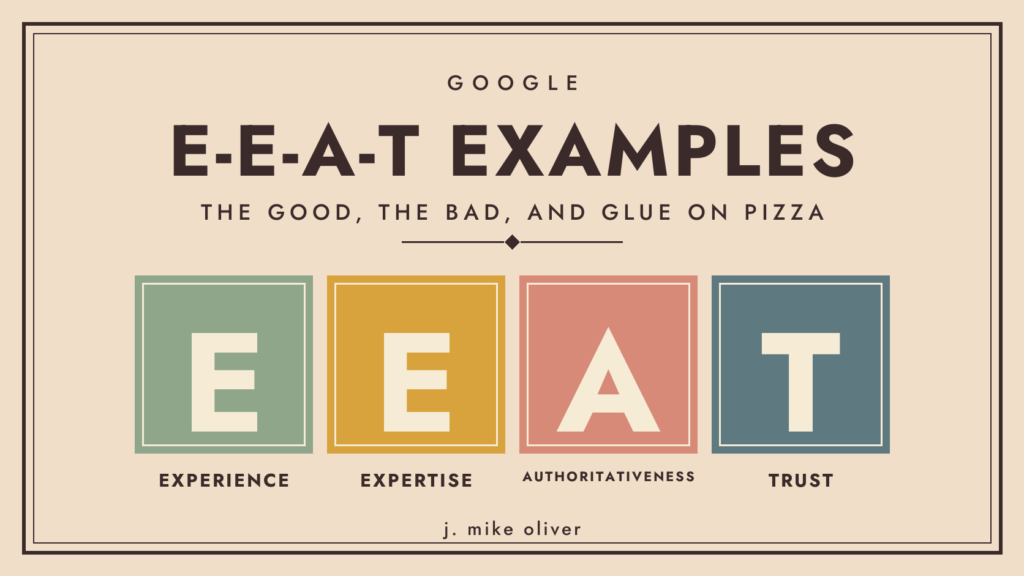
Most E-E-A-T examples online are author bios and About pages. Those are fine. But I learned more from the times Google got it wrong, because they show what the four letters are actually protecting.
What does E-E-A-T mean?
E-E-A-T stands for Experience, Expertise, Authoritativeness, and Trustworthiness. It is the framework Google’s human quality raters use to judge whether a page deserves trust. It is not a direct ranking factor, but it describes what the ranking systems try to reward. Google’s guidelines call trust the most important of the four.
Experience: the glue on pizza answer
In May 2024, Google’s AI Overviews told people to mix non-toxic glue into pizza sauce so the cheese would not slide off. The advice traced back to a joke comment on Reddit from about 11 years earlier. The Register covered Google’s response.
It read like someone who had made a lot of pizza. They had not. Experience is easy to fake in tone. It is hard to fake in specifics: the date, the photo, what went wrong the first time.
Expertise: the rock-eating answer
That same month, someone asked how many rocks to eat. The AI said geologists recommend one small rock a day. Google later acknowledged that answer came from satirical content, and the text was pulled from The Onion. Engadget has the details on the restrictions Google added afterward.
No geologist said that. The sentence was shaped like expertise. Real expertise is whether a person who actually knows would say it.
Authoritativeness: you can’t borrow it
Google’s site reputation abuse policy is aimed at pages from third parties hosted on well-known sites to piggyback on their rankings. Google began enforcing it in early May 2024, and coverage at the time said sections of large publishers were hit. Search Engine Land has the rundown.
The lesson is simple. A strong domain did not save content that was not really the site’s own. Authority comes from the work on the page.
Trust: what it looks like on a local site
This is where a small business can win, because most competitors skip all of it. On a Wesley Chapel, Lutz, or Land O’ Lakes business site, trust looks like:
- A real name and a real face, not “our team.”
- An address and phone number that match your Google Business Profile.
- Photos from jobs you actually did, in towns you actually serve.
- Reviews that mention the specific work, not just “great service.”
- Prices or ranges when you can give them, and a plain line about what you don’t do.
None of that needs a trick. It needs you to show your work.
Does this matter for AI answers?
Yes, and it is the same job. AI tools read the same pages and lean on a search index to pick which ones. If your pages are vague, they get skipped or misquoted. I wrote about how that fits together in what TEO is.
Quick answers
Is E-E-A-T a ranking factor? Not directly. It is what the quality raters look for, and their feedback shapes the algorithms.
Do small local sites need it? Yes. A plumber’s page is the kind of page where trust matters most.
Can AI-written content have E-E-A-T? Only if a real person adds the experience, checks the facts, and puts their name on it.
If you are not sure your site shows any of this, tell me what is not working. My SEO work starts there.