Somebody asked me what TEO stands for last week. I did what you would do and looked it up. Three different searches. AEO has write-ups. GEO has a Wikipedia page. TEO had almost nothing behind it, just people using it like everybody already knew.
So here is the plain answer, and then the part that actually matters.
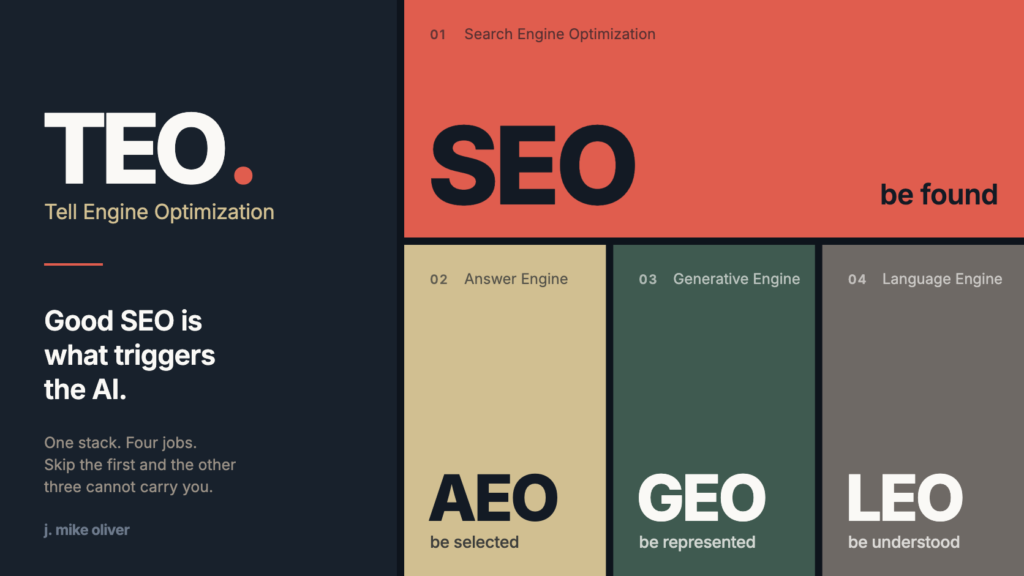
TEO stands for Tell Engine Optimization
It is an umbrella term, and that is the whole point of it. The argument is that the old job and the new job are not two separate fights. They are one pipeline. You want to be found, selected, represented, and understood, and TEO is the name somebody put on all four at once.
Four disciplines sit under it.
SEO, be found
Search Engine Optimization. The floor everything else stands on. Can a crawler reach your pages, do they load fast, do they work on a phone, and do they clearly say what they are about. You measure it in rankings and organic traffic, same as always. It is the least exciting thing on this list and it is still the one that decides the other three, which is most of what I am doing when somebody hires me for SEO.
AEO, be selected
Answer Engine Optimization. Writing short, quotable answers that a search feature can lift and show on its own. You measure it in featured snippets, AI Overviews, and voice results.
GEO, be represented
Generative Engine Optimization. Getting your business included when a model writes a summary instead of handing over a list of links. You measure it in mentions and citations inside ChatGPT, Gemini, Claude, and Perplexity. I have written before about what ChatGPT says about your business, and about why it does not mention you at all.
LEO, be understood
Language Engine Optimization. Saying things explicitly enough that a model cannot fill a gap with a guess. If your site never states plainly what you do and where you do it, something is going to fill that in for you, and you do not get a vote on what it says.
Four labels, one job. Get the machine to tell people about you, and tell them the truth.
Why anybody bothered naming it
Because the behavior changed faster than most businesses noticed. A lot of research now ends in a conversation instead of a page of blue links. Somebody asks a question, gets one paragraph back, and never clicks anything. I wrote about zero click searches a while back and nothing about that trend has reversed since.
If all of your visibility depends on somebody scrolling to a tenth blue link, you have a problem that is only going to get worse.
Here is the part people skip: good SEO is what triggers the AI
This is the thing I keep saying and it keeps not landing, so let me say it as plainly as I can.
There is no second internet for the AI. These models are not crawling a special version of your website. They read the same pages Google reads, and most of the time they are leaning on a search index to decide which pages are worth reading at all. ChatGPT runs searches. Perplexity runs searches. Google’s AI Overviews are built on top of Google’s own index.
Which means your page has to already be in the pool before any of the clever stuff matters.
- If a crawler cannot reach your page, no amount of answer-first formatting saves it.
- If your site is slow and broken on a phone, you are losing the same points you have always lost.
- If nothing anywhere else on the web mentions your business, there is nothing for a model to repeat.
Good SEO is not the old thing you finish before you get to the new thing. It is the trigger. Everything labeled AEO, GEO or LEO is a refinement that only pays off once the SEO underneath it is doing its job. Skip the foundation and you have built a beautifully structured page that nothing can find.
The good news is that if you have been doing this right for years, you already did most of the work.
How to actually run a TEO strategy
Four things, in order.
1. Write answer first. Make the header the question somebody actually typed, then put a direct answer under 50 words right beneath it, then go as deep as you want under that. The short answer is the part a machine can quote. The depth is the part that earns the ranking.
2. Use schema, and use a lot of it. AI engines cannot reliably parse clever marketing copy. Schema markup is how you label your own information so there is nothing left to interpret. Organization, LocalBusiness, Product, FAQ, HowTo. It is boring and it works.
3. Get mentioned somewhere that is not your website. This is the one everybody ignores. The crawlers do not only read your site, they weigh what the rest of the web says about you. Reddit threads, YouTube, industry forums, local news, review sites. Reviews most of all, which is why I keep going on about getting reviews and answering them.
4. Serve real HTML. The crawlers feeding these models are bad at JavaScript. If your content only appears after a script runs, there is a decent chance the bot sees an empty page. Server-side rendering, or at the very least make sure the words are in the page source.
Where I would start if that felt like a lot
It is a lot. If you run a small business and nobody there does this full time, ignore the acronyms completely and do these three things:
- Fill out your Google Business Profile all the way. Hours, services, service area, photos, all of it.
- Get reviews, and answer every single one, including the bad ones.
- Write one page for each real question your customers ask, with the answer at the top.
That is most of TEO, done without ever saying the word schema out loud. And if you are already getting traffic but no calls, this is usually where the gap is hiding.
So is TEO a real thing, or just another acronym?
Honest answer: the label is new and I have no idea whether it sticks. This industry invents one of these about every eight months. AEO, GEO, AIO, AISO, Search Everywhere Optimization, and now TEO.
But the stack it describes is real and the order is right. Be found, then be selected, then be represented, then be understood. Call it whatever you want. What you cannot do is skip the first one and expect the other three to carry you.
Want me to look at yours?
If you want to know what the AI is currently saying about your business, and whether your website is giving it anything accurate to work with, tell me what is not working and I will go look. I am in Tampa, and you get me on the phone, not a ticket queue.