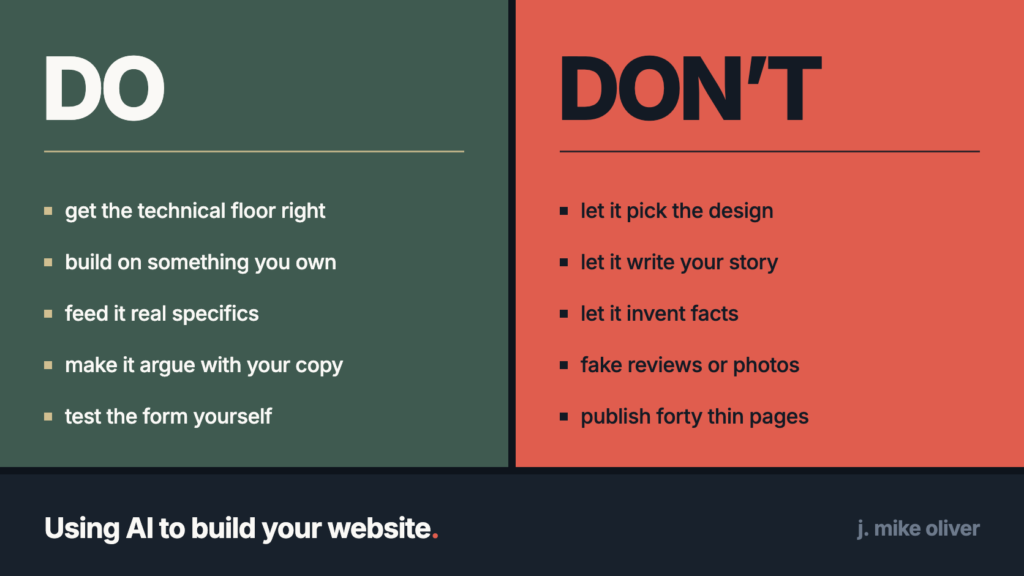
I get asked about this almost every week now. Somebody has seen a tool that promises a finished website in ten minutes, and they want to know whether it really works or whether it is going to embarrass them.
Both, usually. Which one you end up with depends almost entirely on what you hand the AI and what you let it decide on its own.
So here is how I would use it, and where I would keep my hands on the wheel.
What AI is actually good at
It is very good at the parts of a website that are tedious and have a right answer. Alt text for forty images. Turning a messy list of services into clean headings. Writing a redirect rule. Tightening up a paragraph you wrote at eleven at night. Checking whether every page has a title tag.
It is also good at being a first draft you can argue with. A blank page is slow. A mediocre draft is fast to fix, because you can see exactly what is wrong with it.
What it is not good at is knowing anything about your business that is not already on the internet. It cannot tell me why your customers pick you over the shop two miles down the road. If you do not tell it, it will invent something that sounds fine and means nothing, and you will not notice because it reads smoothly.
The do’s
Get the technical floor right first
Fast hosting, HTTPS, a sitemap, pages that load their content without waiting on JavaScript, a mobile layout that actually works with a thumb. AI will happily help you check every one of these. It will not save you if you skip them, because nothing else counts until they are in place. Search engines and the AI tools people now ask for recommendations are reading the same pages, and both of them give up on a slow one. That connection is the whole point of what I call TEO.
Build on something you own
Plenty of these tools will build you a beautiful site that lives inside their platform and cannot leave. Before you put thirty hours into it, find out whether you can export the thing, point your own domain at it, and keep the content if you stop paying. If the answer is no, you are renting your business address.
Feed it real specifics
This is the single biggest difference between a site that sounds like a person and one that sounds like a brochure. Give it the real stuff. The town names. The actual brands you service. The question customers ask on the phone every single day. The thing that went wrong on a job last year and how you fixed it. Generic input gets generic output, every time.
Make it argue with your copy
The most useful prompt I use is not “write me a page.” It is closer to “here is my page, now tell me what a skeptical customer would still be worried about after reading it.” AI is a decent critic. It is a mediocre writer. Use it in the role it is better at.
Test the form yourself
Fill out your own contact form. Send it. See if the email arrives, and see where it lands. I have lost count of the sites I have opened where the form was silently broken and nobody knew, which meant months of traffic going nowhere. An AI builder will not catch that for you. If you are already getting visitors and no phone calls, that is worth ruling out first, and I went through the usual culprits in this post.
The don’ts
Do not let it pick the design
Ask an AI for a layout and you get the same layout everybody else got. Big gradient hero, three icon cards, a wall of identical testimonials, a dark footer. It is not ugly. It is just forgettable, and it reads as a template to anybody who looks at websites for a living. Pick your own colors and your own type, even if that just means two colors and one typeface. It will look more deliberate than the default.
Do not let it write your story
Your about page, your founding story, why you do this work. That is the one section where the AI has nothing to work with and the most incentive to make something up. It will produce warm, rounded, completely hollow sentences about passion and commitment. Write that page yourself, badly if you have to. Badly and true beats polished and fake.
Do not let it invent facts
This is the one that gets people in real trouble. AI will cheerfully write that you offer 24-hour emergency service, that you have been in business since 1998, that you are licensed and bonded in three states. If any of those is wrong, you have published a false claim with your name on it. Read every number, date, credential, guarantee, and price before it goes live.
Do not fake reviews or photos
Do not generate testimonials. Do not use an AI image of a smiling technician and call it your team. People can tell, Google can tell, and in a lot of industries it is flatly illegal. If you do not have photos yet, use fewer photos. An honest, sparse page beats a staged one.
Do not publish forty thin pages
AI makes it trivially easy to spin up a page for every service in every town you can think of. Do not. Forty near identical pages compete with each other, dilute the site, and signal low effort to exactly the systems you are trying to impress. Five pages that genuinely say something different will outperform forty that do not.
How people can tell
The tells are consistent. Every paragraph is the same length. Every section has exactly three bullet points. Words like leverage, robust, seamless, and elevate. Sentences that could describe any company in any industry. No numbers, no names, no town, no specifics. A tone that is relentlessly upbeat and never says anything that might be slightly unflattering.
If you want the quick test, read a page out loud. If it does not sound like something you would actually say to a customer standing in front of you, it needs another pass.
Where I would stop and get help
Honestly, most small businesses can get a perfectly good five page site out of these tools now. That was not true two years ago.
Where I would stop is when money starts riding on it. If the site has to rank for competitive terms, if you are running ads to it, if you are migrating an existing site and have to keep your rankings, or if something is already broken and you cannot figure out what, that is the point where guessing gets expensive. A bad migration can erase years of work in an afternoon, and no builder warns you before it happens.
The short version
Use AI for the boring parts and the first drafts. Keep your hands on the design, the facts, and the story. Check anything it claims about you. Build on something you own. Then read it out loud before you publish.
If you have built something with one of these tools and you are not sure whether it is working, send me the link. I will tell you straight. Get in touch here.